Program 01 of 6
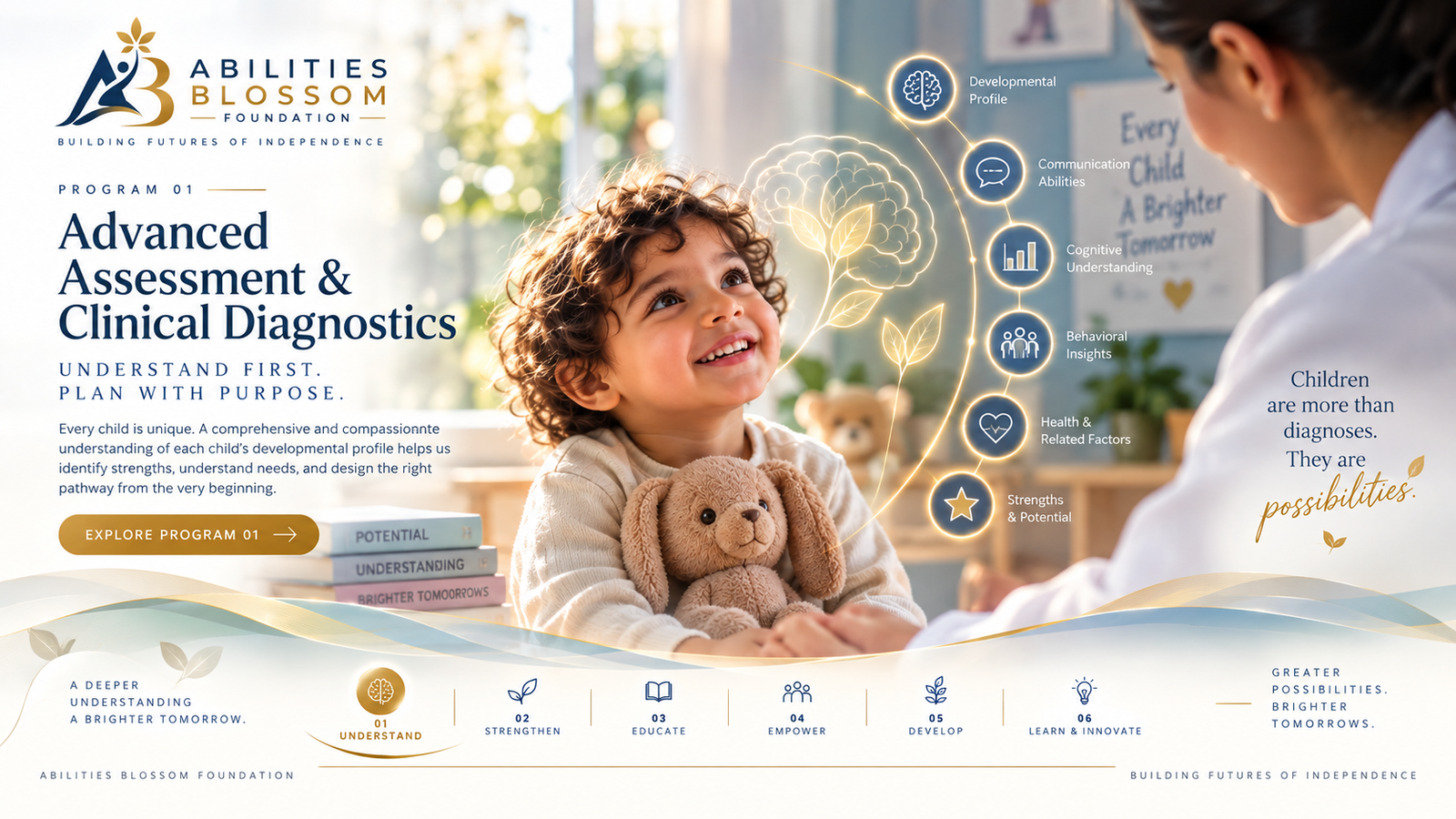
Advanced Assessment
& Clinical Diagnostics
Understand First.
Plan With Purpose.
Before we decide how to support
a child, we must first
understand the child.
Every child is more than a diagnosis.
Meaningful support begins with understanding the individual child—their strengths, needs, abilities, circumstances, environment, and priorities.
Children with developmental disabilities may have needs and strengths across development, communication, learning, behavior, health, nutrition, daily functioning, and family life. When these areas are considered separately, important connections may be missed, recommendations may become fragmented, and families can be left trying to bring different pieces of information together themselves.
At Abilities Blossom Foundation, our planned approach to assessment is designed to bring relevant perspectives together to build a more complete understanding of each child and provide a stronger foundation for what comes next.
Because before we decide how to support a child, we must first understand the child.
Why It Matters
Understanding Comes Before Planning.
Assessment should do more than produce a diagnosis, test result, or report. It should help families and professionals answer the questions that matter:
Who is this child?
What are their strengths and abilities?
Where are they experiencing challenges?
What factors may be influencing their development, communication, learning, participation, or everyday life?
What should families and professionals prioritize next?
A diagnosis may contribute important information, but it cannot describe the whole child.
By bringing relevant information together, assessment can create a stronger foundation for individualized planning, shared priorities, and coordinated support.
The goal is not simply to identify what a child needs help with. It is to understand the child well enough to make better decisions about what comes next.
A Whole-Child Perspective
Bringing Relevant Knowledge Together.
No single assessment can explain every aspect of a child's development or everyday life. Depending on the individual child and the expertise required, our planned assessment pathway may bring together relevant perspectives across:
Development
Understanding developmental strengths, needs, abilities, and patterns of progress over time.
Communication
Understanding how the child communicates, understands others, expresses needs, interacts, and participates.
Learning & Education
Understanding the child's learning profile, abilities, participation, educational needs, and opportunities for development.
Behavior & Daily Functioning
Understanding behavior in context and how the child navigates routines, activities, environments, and everyday demands.
Health & Nutrition
Considering relevant health, nutritional, and developmental information that may contribute to a fuller understanding of the child.
Family Knowledge
Listening to the people who know the child's history and everyday life—strengths, challenges, preferences, routines, priorities, and aspirations.
Clinical Diagnostics: Where clinically appropriate, specialized diagnostic investigations may provide additional information to support decision-making by appropriately qualified professionals, subject to applicable professional, ethical, and regulatory requirements.
Not every child will need every assessment, professional, or investigation.
The purpose is not to do more. It is to understand what is relevant for each individual child.
How the Program Is Intended to Work
From Understanding to Action. Assessment becomes meaningful when information leads to better decisions. Our planned pathway follows five connected stages:
Understand
Begin with the individual child—their strengths, needs, abilities, history, circumstances, environment, and family priorities.
Connect Knowledge
Bring together relevant information from families and appropriately qualified professionals so that important insights are considered in context rather than remaining isolated.
Identify Priorities
Determine which strengths, needs, opportunities, and concerns are most meaningful for the child's development, participation, learning, and everyday life.
Build the Plan
Use that understanding to inform an individualized pathway with meaningful goals and appropriate areas of support.
Review & Adapt
As the child develops, progress is reviewed, circumstances are reconsidered, and priorities or strategies can evolve when appropriate.
Assessment therefore becomes more than a single event. It becomes the beginning of an evolving pathway.
Families as Essential Partners
Families Bring Knowledge No Test Can Replace.
Professionals may see a child during an assessment, consultation, classroom activity, or appointment. Families see the child across everyday life.
They understand routines, relationships, communication, preferences, challenges, successes, and environments that may not be fully visible during a professional assessment. Their knowledge provides essential context.
Our approach therefore aims to involve families meaningfully in understanding the child and establishing priorities. Family perspectives may contribute insight into:
Professionals bring specialized expertise. Families bring lived knowledge.
A more complete understanding becomes possible when both are heard.
From Assessment to Individualized Planning
Information Should Lead Somewhere. A collection of reports is not an integrated plan. The value of assessment lies in what happens next.
Relevant findings can help inform the child's wider pathway across education, health, nutrition, development, family partnership, and other appropriate areas of support.
Goals can then be established around what matters for the individual child rather than around a diagnosis alone. As progress is reviewed and new information emerges, the pathway can evolve.
Assessment should not become another disconnected service. It should help connect the journey.
Connection to the Independence Model™
Understanding Is Where the Journey Begins.
Within the Abilities Blossom Independence Model™, understanding comes first:
Assessment contributes directly to the Understanding component of the equation.
But understanding is not the destination. Its value comes from helping families and professionals make better-informed decisions about the child's next steps and creating stronger connections between knowledge, goals, and support.
Understand the Child. Then Build the Pathway.
What We Aim to Learn & Measure
Building Accountability From the Beginning.
As this program becomes operational, we intend to establish appropriate measures that help us evaluate both the quality of the assessment process and how effectively it contributes to individualized planning and coordinated support.
Depending on the program's final operational design, areas for evaluation may include:
We will distinguish between activities and outcomes. The number of assessments completed may tell us how much activity has taken place. It does not, by itself, tell us whether children and families are receiving better understanding, clearer direction, or more coordinated support.
Measurement should help us learn—not simply help us count.
Our Principle
A Diagnosis Can Provide Information. It Should Never Define the Child.
We seek to understand the individual behind the diagnosis—their abilities, strengths, needs, circumstances, relationships, priorities, and possibilities.
Because the purpose of assessment is not simply to find a label. It is to help families and professionals see the child more clearly, make more informed decisions, and build a pathway that can evolve with them.
Understand First. Plan With Purpose. Build Toward Greater Independence.