Program 02 of 6
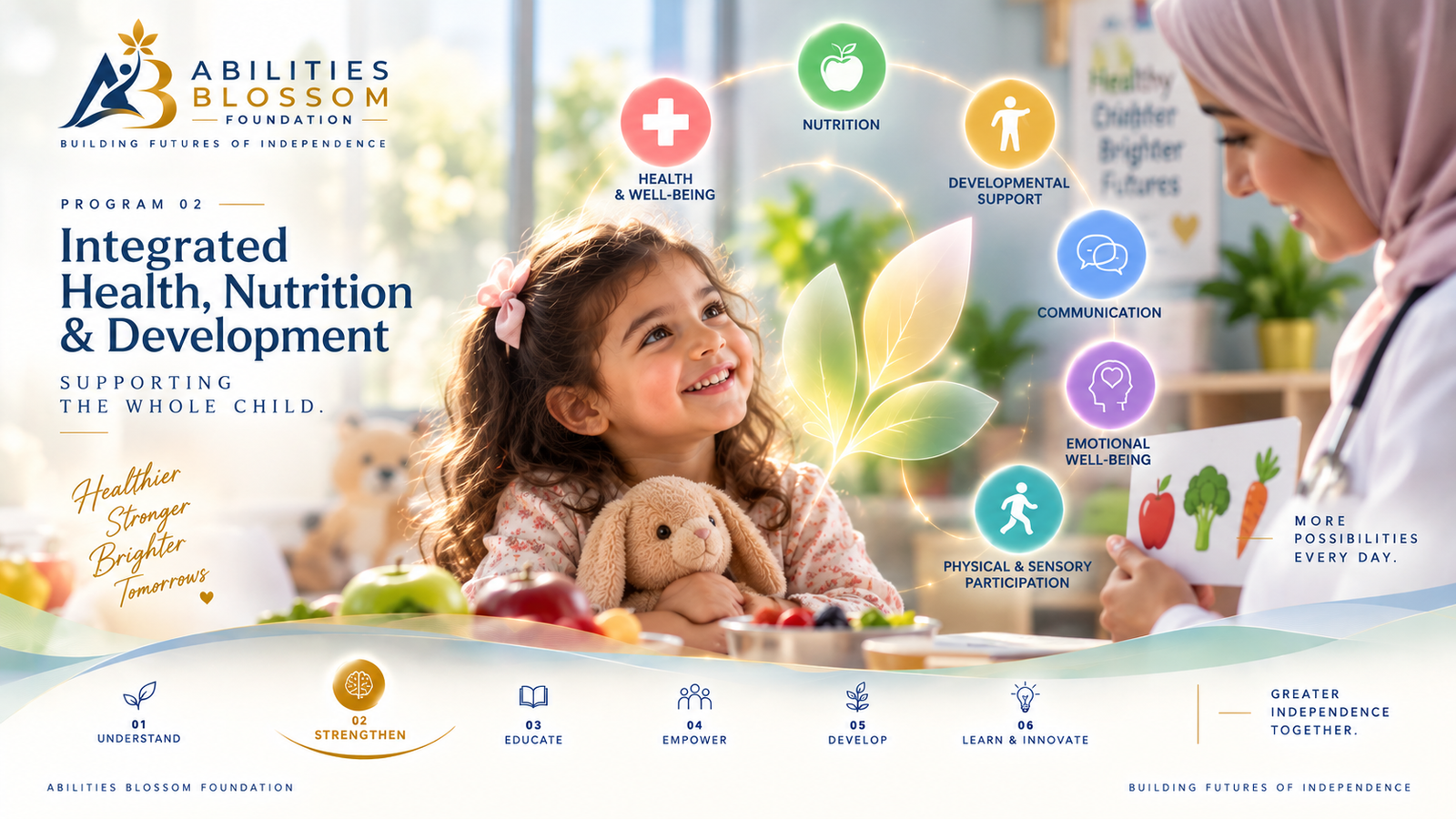
Integrated Health,
Nutrition & Development
Supporting the
Whole Child.
A child does not experience health,
development, and everyday life
as separate systems.
A child does not experience health, development, communication, emotions, learning, and everyday life as separate systems.
They are parts of one life.
At Abilities Blossom Foundation, our planned approach recognizes that a child's ability to participate, communicate, learn, develop, and engage in everyday life may be influenced by a range of interconnected factors.
Program 02 is designed to bring relevant health, nutrition, developmental, and well-being perspectives into the child's wider pathway—working alongside education, family partnership, and other appropriate forms of support.
The purpose is not to search for one explanation, one intervention, or one solution.
It is to understand what matters for the individual child and coordinate appropriate support around the whole child.
Why It Matters
Development Does Not Happen in Isolation.
Children grow and develop within the realities of their bodies, relationships, environments, routines, experiences, and everyday lives.
For some children, health concerns may require appropriate medical attention. Nutritional needs may require qualified assessment and guidance. Developmental differences may affect communication, participation, daily functioning, or how a child engages with different environments.
Emotional well-being, physical comfort, movement, sensory experiences, sleep, eating, and everyday routines may also be relevant to the child's experience.
These factors should not be ignored. Nor should they be treated as universal explanations for developmental disability. They should be considered individually, responsibly, and within the appropriate professional scope.
Supporting the whole child means understanding which factors matter for this child—and responding to them appropriately.
A Whole-Child Approach
Different Needs Require Different Expertise. Program 02 is intended to connect appropriate expertise around three closely related areas of the child's life:
Health & Well-Being
Relevant medical care, nutrition, physical well-being, and other health considerations addressed by qualified professionals when needed—not to medicalize every difference.
Development & Functioning
Support focused on abilities that matter in everyday life—communication, movement, sensory participation, and daily living skills.
Participation in Everyday Life
Progress that matters beyond appointments—greater communication, comfort, choice, confidence, or independence.
Individual needs should shape support—not a predetermined package of services.
How the Program Is Intended to Work
From Understanding to Coordinated Support. Program 02 builds on the understanding developed through assessment and individualized planning. Its planned pathway follows six connected stages:
Understand Needs
Consider relevant information about the child's health, nutrition, development, functioning, environment, everyday life, and family priorities.
Identify Priorities
Not everything needs to be addressed at once. Families and relevant professionals can identify what matters most.
Connect Expertise
Involve appropriately qualified professionals according to the child's individual needs rather than a standard team for every child.
Coordinate Support
Where different professionals are involved, encourage communication and alignment around meaningful priorities and clear roles.
Review Progress
Consider what is changing and whether agreed priorities and approaches remain appropriate.
Adapt
As the child develops or better information becomes available, the pathway should be able to evolve.
The purpose is not more services. It is better-connected support.
Individualized, Not One-Size-Fits-All
Every Child's Pathway Will Be Different.
Two children with the same diagnosis may have very different abilities, health considerations, developmental profiles, nutritional needs, family circumstances, environments, and priorities.
For that reason, Abilities Blossom Foundation does not intend to build this program around a universal protocol. We do not assume that one diet, intervention, therapy, clinical pathway, or developmental strategy is appropriate for every child.
Support should be guided by the child's individual needs, appropriate professional judgment, relevant evidence, family priorities, and ongoing review.
The question is not: "What do we give every child?" The question is: "What is appropriate and meaningful for this child?"
Families as Partners
Support Must Make Sense in Everyday Life.
Families experience the practical realities of a child's health, development, communication, routines, eating, behavior, participation, and daily activities. Their observations can provide essential context about what happens beyond an appointment, assessment, or structured setting.
Our approach therefore aims to involve families in:
It is to create a partnership in which professional expertise and family knowledge contribute to one coherent pathway around the child.
From Separate Appointments to a Connected Pathway
Different Expertise. One Shared Direction.
A child may need support from more than one professional. That is not necessarily the problem. The problem arises when each professional sees only one part of the child and those parts never reconnect.
Program 02 is therefore designed around coordination, not professional duplication. Doctors remain responsible for appropriate medical care. Nutrition professionals contribute expertise within their scope. Developmental professionals support relevant priorities. Educators contribute knowledge of learning and participation. Families bring essential knowledge of everyday life.
The goal is not for everyone to do the same job. It is for different expertise to contribute to one coherent direction.
Progress in Everyday Life
Outcomes Should Matter Beyond the Appointment.
Progress does not have one definition. For one child, meaningful progress may involve communicating a need more effectively. For another, it may mean participating more comfortably in a routine, developing a functional skill, making choices, or becoming more independent in an aspect of daily life.
Progress may mean greater independence. It may also mean greater participation, communication, comfort, choice, confidence, or quality of everyday life.
Connection to the Independence Model™
Strengthening the Foundations for Participation and Development.
Within the Abilities Blossom Independence Model™:
Program 02 contributes particularly to the Health component while remaining connected to the rest of the equation.
Support the Whole Child. Strengthen the Pathway.
Evidence, Expertise & Responsible Practice
Innovation With Purpose. Practice With Responsibility.
Our planned approach is to combine individualized understanding with appropriately qualified expertise, relevant evidence, ethical practice, family partnership, and applicable professional and regulatory standards.
New and emerging approaches should be considered carefully rather than adopted simply because they are new, popular, or promising. Where evidence is uncertain, that uncertainty should be acknowledged. Where specialist care is required, appropriate referral should be part of responsible practice.
Innovation should strengthen responsible practice—not replace it.
What We Aim to Learn & Measure
Measuring What Matters in Everyday Life. Depending on individual goals and the final operational design, areas for evaluation may include:
We will distinguish between activity and meaningful progress.
We measure progress against meaningful individual goals—not against a single definition of success.
Our Principle
The Whole Child. Not a Collection of Conditions.
A child's future cannot be reduced to a diagnosis, laboratory result, diet, therapy, or classroom. Each may contribute one part of a much larger picture.
Our purpose is to connect what is relevant responsibly—around the individual child, their family, their priorities, and their evolving journey.
Support the Whole Child. Coordinate What Matters. Build Toward Greater Independence.