Program 03 of 6
Education for
Independence
Learning for Life.
We do not educate only
for the next exam. We educate
for the next stage of life.
Education should prepare children for more than the next lesson, examination, or school year.
It should help them communicate, think, participate, solve problems, build relationships, develop practical abilities, make choices, and navigate everyday life with increasing confidence.
At Abilities Blossom Foundation, our planned educational approach places the individual child at the center of learning.
Academic development matters. But education should also help children build the abilities they need to participate more meaningfully in their families, schools, communities, and future lives.
We do not educate only for the next exam. We educate for the next stage of life.
Why It Matters
Education Should Open Possibilities.
Children with developmental disabilities can experience barriers to learning that extend beyond the academic curriculum. Some may need different ways to communicate. Some may need additional time, structure, repetition, visual support, environmental adaptations, assistive tools, or individualized teaching approaches.
The answer should not be lower expectations simply because a child learns differently. Nor should success be defined by forcing every child toward the same destination.
The challenge is to create meaningful opportunities for each child to learn, participate, develop, and progress from their own starting point.
The Individual Child at the Center
Understand the Learner. Then Design the Learning. Education should begin with questions such as:
How does this child learn?
How do they communicate?
What motivates and engages them?
What are their strengths?
Where are the barriers to participation?
What abilities are most important now—and for the next stage of life?
Individualization does not mean expecting less. It means creating a more meaningful pathway for progress.
Learning Across the Whole Child
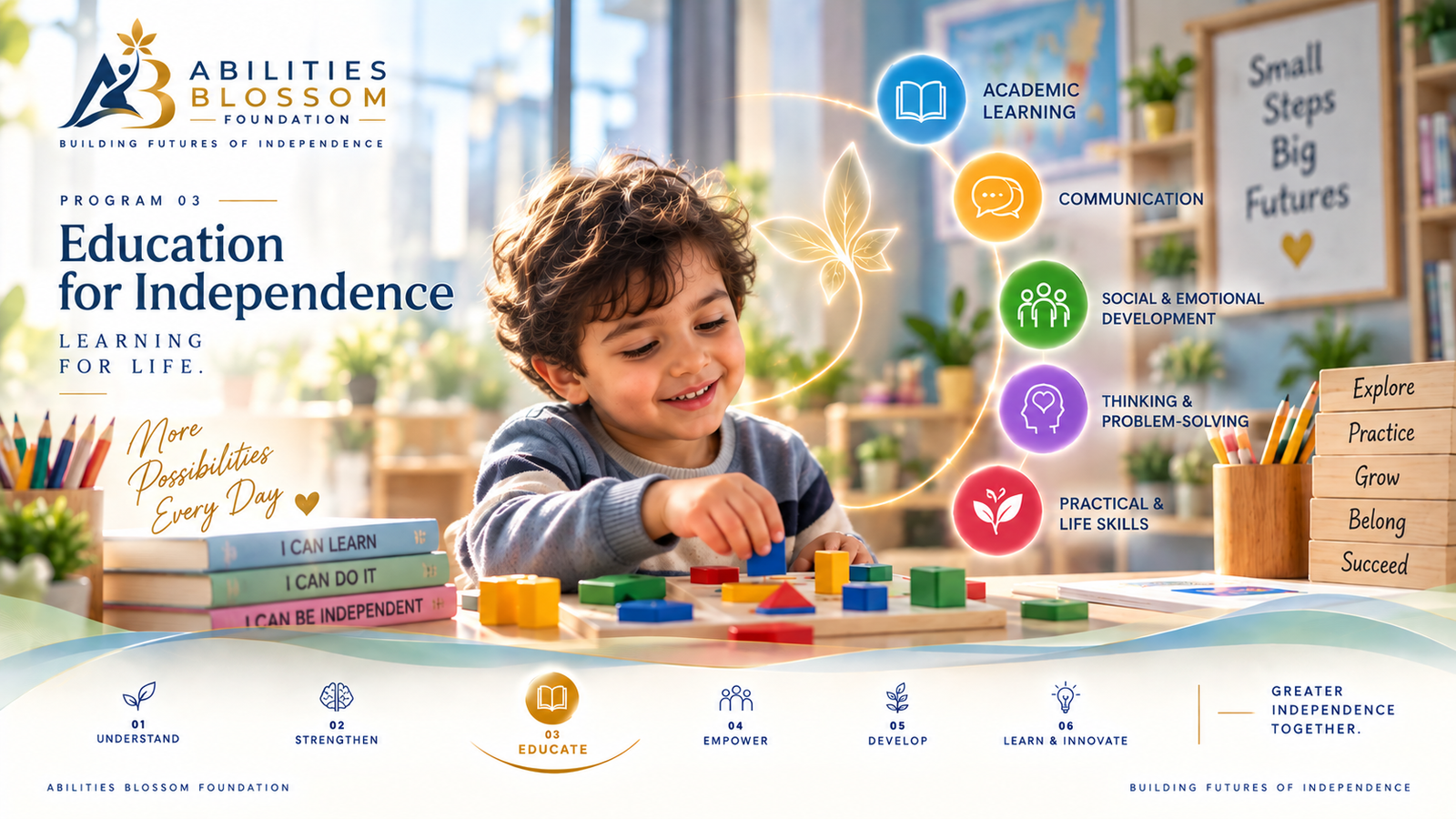
More Than Academic Achievement. Depending on the individual learner, this may include development across five interconnected areas:
Academic Learning
Building appropriate knowledge and skills across literacy, numeracy, science, creativity, and technology.
Communication
Supporting children to understand, express needs and ideas, make choices, and interact with others.
Thinking & Problem-Solving
Developing attention, curiosity, decision-making, flexibility, and applying learning beyond a single lesson.
Social & Emotional Development
Supporting relationships, self-awareness, emotional development, confidence, and resilience.
Practical & Life Skills
Developing abilities relevant to everyday living, self-care, organization, choice, and increasing independence.
They are part of preparing a child to participate in life.
How the Program Is Intended to Work
From Understanding to Meaningful Learning. The planned educational pathway follows a continuous process:
Understand the Learner
Use relevant assessment information, educational observation, family knowledge, and professional expertise.
Set Meaningful Goals
Establish individualized priorities reflecting educational needs, strengths, and future direction.
Design the Learning
Use appropriate teaching methods, environments, materials, technology, and adaptations.
Support Participation
Help the child become an active participant in learning rather than simply a recipient of instruction.
Apply Skills
Create opportunities for learning to move beyond a worksheet, lesson, or classroom.
Review & Adapt
Monitor progress, consider what is helping or creating barriers, and adjust when needed.
Education should evolve as the child evolves.
Individualized Learning. Meaningful Expectations.
Different Pathways. Real Possibilities.
Individualization should never become another word for limitation. Children may require different goals, teaching strategies, levels of support, communication methods, or timelines. But every child should have opportunities to develop.
Progress should not be judged solely by comparison with other children. It should also be understood in relation to the child's own abilities, goals, starting point, and development over time.
Different does not mean less. Individualized does not mean without ambition.
Communication Is Access
Every Child Needs a Way to Participate.
A child who cannot communicate effectively may understand far more than they are able to demonstrate. For some children, spoken language may be one part of communication. For others, appropriate alternative or augmentative communication approaches may support expression, understanding, choice, and participation.
The purpose is to help every child have the strongest possible way to understand, express, choose, connect, and participate.
From the Classroom to Everyday Life
Learning Becomes Powerful When Children Can Use It. A skill demonstrated in one structured setting does not automatically become a skill a child can use elsewhere.
A mathematical concept may support everyday decision-making. Communication may support choice and self-advocacy. Literacy may expand access to information. Social learning may strengthen participation in relationships and community life.
The classroom is an important place to learn. Life is where learning must ultimately have meaning.
Families as Educational Partners
Learning Connects School and Everyday Life. Our planned approach aims to involve families in appropriate ways through:
It is to help the child's educational pathway connect meaningfully with the life they are living and the future they are preparing for.
Preparing for What Comes Next
Education Should Look Forward. As children become older, increasing attention may be given to self-advocacy, decision-making, practical life abilities, technology, community participation, and preparation for adult life.
The skills for tomorrow are built through opportunities created today.
Connection to the Independence Model™
Learning Should Build Capability.
Within the Abilities Blossom Independence Model™:
Program 03 contributes particularly to the Learning component—but learning is strengthened by the rest of the equation.
It is to build knowledge, communication, capability, participation, and skills for life.
Evidence, Expertise & Inclusive Practice
High Expectations Need Strong Practice. Meaningful inclusion requires more than placing children in the same physical environment. Children need genuine opportunities to access learning, communicate, participate, and make progress.
Inclusion is not simply being present. It is having a meaningful opportunity to participate, learn, and belong.
What We Aim to Learn & Measure
Measuring Progress That Matters. Individualized goals and appropriate educational measures may help us understand progress across areas such as:
We also ask what the child is increasingly able to understand, communicate, apply, choose, participate in, and do.
Our Principle
Education Is Preparation for Life.
A child's education should never be reduced to completing lessons, collecting grades, or progressing through school years. Education should expand possibilities.
Learn. Communicate. Participate. Build Skills for Life.