Program 06 of 6
Research, Innovation &
International Collaboration
Learn. Improve. Share.
A strong organization does not
simply deliver programs.
It learns from them.
No organization begins with all the answers.
And no organization committed to children and families should ever stop asking better questions.
At Abilities Blossom Foundation, research, innovation, and collaboration are intended to help us understand what is working, identify what needs to improve, explore responsible new possibilities, and strengthen practice over time.
We want to learn from evidence, from experience, from children and families, and from professionals, researchers, universities, and communities in Egypt and internationally.
Because a strong organization does not simply deliver programs. It learns from them.
Why It Matters
Good Intentions Are Not Enough. A program can be well designed and still need improvement. An approach that works in one setting may not work in another.
The goal is not to prove that we are always right. It is to keep learning how we can do better.
A Learning Organization
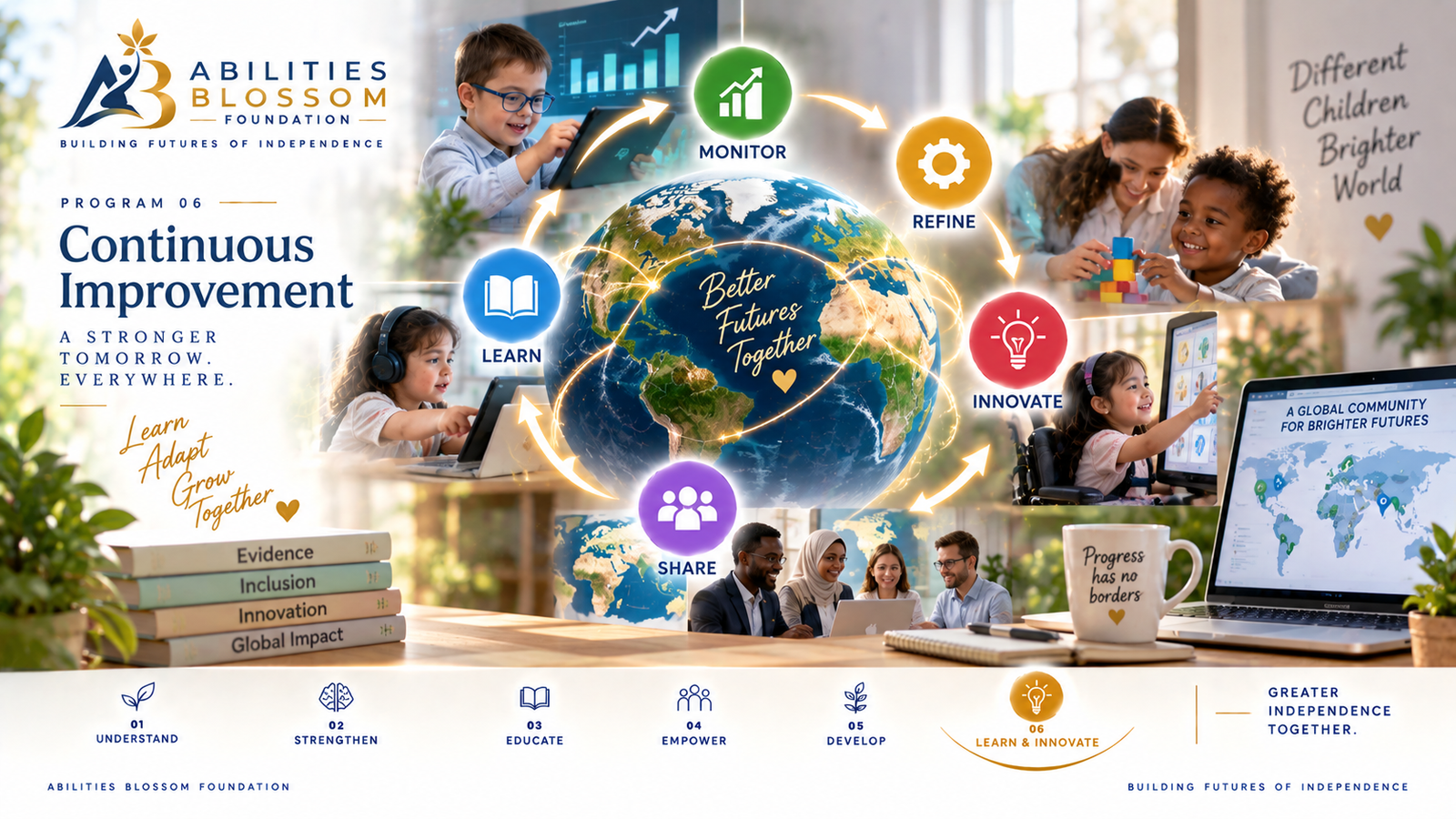
Every Program Should Teach Us Something. Program 06 connects streams of knowledge from Programs 01–05 and asks what we are learning—and what we should do differently because of it. That creates a continuous cycle:
Three Engines of Learning
Research. Innovation. Collaboration. Program 06 is designed around three interconnected areas:
Research & Evaluation
Understanding needs, examining implementation, and evaluating programs to contribute to better decisions.
Innovation
Exploring responsible new ideas, approaches, and technologies that may improve quality and outcomes.
International Collaboration
Building purposeful relationships with universities and organizations in Egypt and internationally.
Research helps us understand. Innovation helps us explore. Collaboration helps us learn beyond ourselves.
Research With Purpose
Start With Questions That Matter. Over time, areas of inquiry might include questions such as:
How effectively are different services being coordinated?
Which approaches are helping children participate more meaningfully?
How do families experience the support pathway?
What barriers make participation or access more difficult?
Which aspects of our programs should be improved or reconsidered?
Both outcomes are valuable if they help us improve.
From Data to Better Decisions
Measurement Should Lead Somewhere. The process should be purposeful:
Data should not exist simply to fill reports. It should help us make better decisions.
Responsible Innovation
New Is Not Automatically Better. Before pursuing an innovation, we should ask:
Innovation is not about being first. It is about finding better ways to serve real needs.
Technology With Purpose
Tools Should Serve People. Technology should never become the center of the model. Children and families remain at the center.
We should ask, "Is this technology an appropriate way to solve a problem that matters?"
International Collaboration
Learn Globally. Strengthen Locally. Contribute Back. What works in another country may require adaptation before it is appropriate in Egypt.
Egypt should not only receive knowledge. Egypt can contribute knowledge too.
Partnerships With Purpose
A Partnership Should Create Value. Potential collaborations may include:
Partnership is not about association. It is about contribution.
Children and Families in the Learning Process
Research Should Remain Connected to Real Lives. Privacy, dignity, informed consent or appropriate permission, safeguarding, and the child's best interests must remain central.
We should not only study what happens to children and families. We should listen to what they tell us matters.
Ethics, Safeguarding & Responsible Research
Learning Must Never Come at the Expense of People. Participation in research should not determine whether a child or family can access services.
Knowledge matters. How we obtain it matters just as much.
From Evidence to Practice—and Back Again
Closing the Learning Loop. Program 06 connects directly with Program 05 and feeds learning back across Programs 01–04.
Knowledge should move. Practice should evolve.
Connection to the Independence Model™
Continuous Improvement Keeps the Model Alive. Within the Abilities Blossom Independence Model™:
Program 06 contributes particularly to Continuous Improvement—but its role extends across the entire equation.
The Independence Model™ should not become a fixed formula. It should remain a living model—learning, evaluating, adapting, and improving over time.
What We Aim to Learn & Measure
Are We Becoming a Better Organization? Areas for evaluation may include:
We ask, "What did we learn—and what became better because we learned it?"
From One Foundation to Wider Learning
Knowledge Should Travel Beyond Our Walls. The long-term pathway becomes:
When something useful is learned, its value should not end at our doors.
Our Principle
Never Stop Learning.
Children with developmental disabilities deserve systems that learn as actively as we ask children themselves to learn.
Learn. Improve. Share. Better Knowledge. Better Practice. Greater Possibilities.